
Many site owners look for the “formula” to appear in Google’s AI answers. The official documentation is plainer than you might think.
Here is what Google writes, what it means for a WordPress site, and what remains speculation.
Do you need special optimisation for AI Overviews?
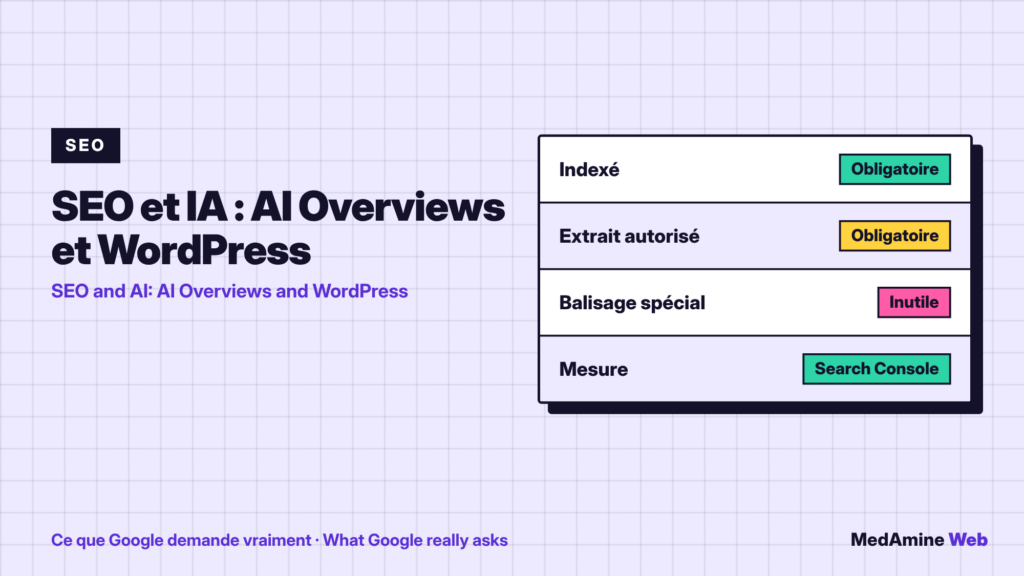
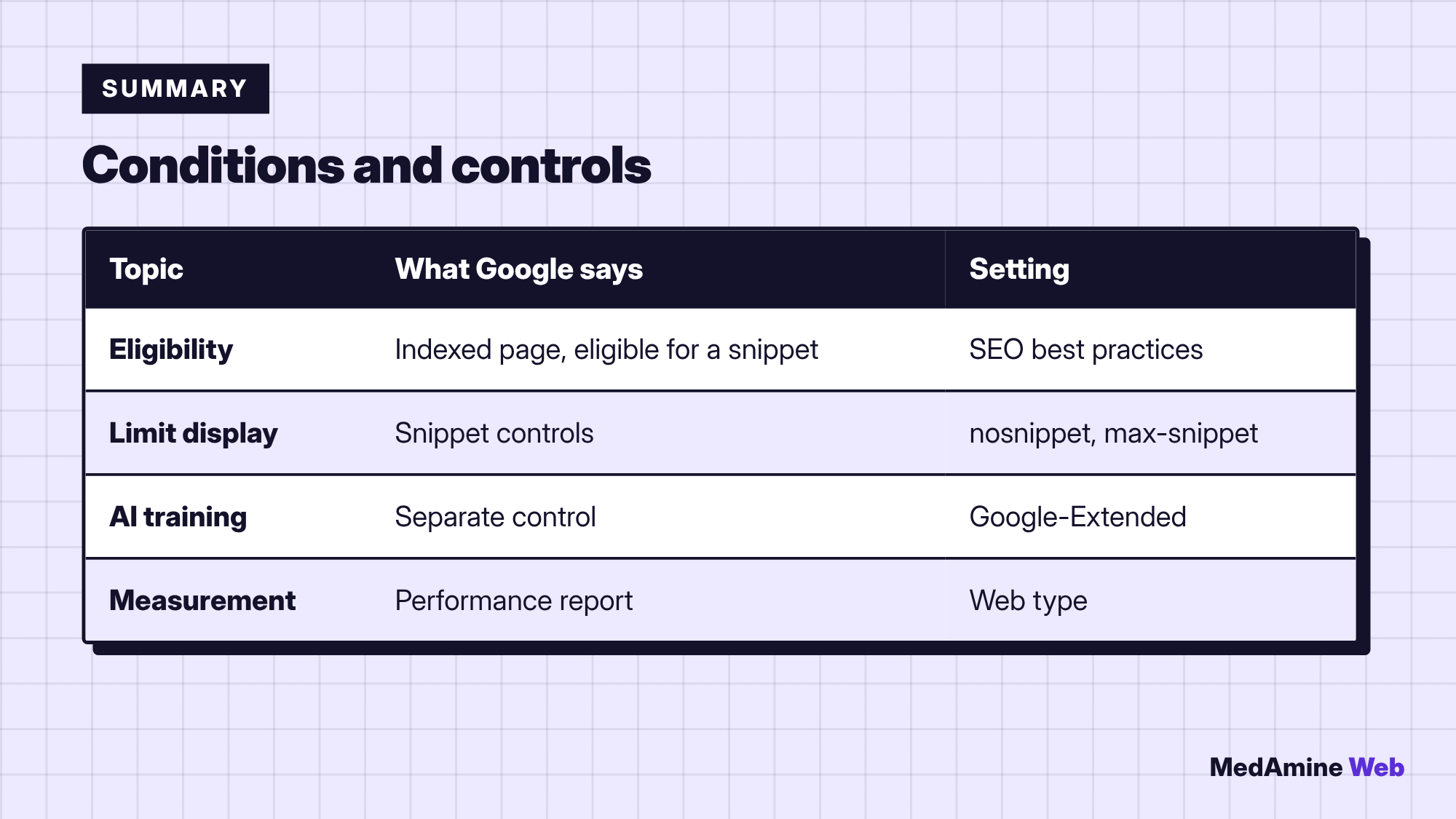
According to Google’s documentation, no: the usual SEO best practices also apply to AI Overviews and AI Mode. There is no extra technical requirement beyond normal search eligibility.
Promises of secret formulas should therefore be treated with caution.
Which conditions must the page meet?
- Be indexed by Google.
- Be eligible for a snippet in results.
- Meet the technical requirements of search.
Google specifies that meeting these conditions does not guarantee that the page is crawled, indexed or shown.
Do you need extra files or special markup?
No. The documentation says you need neither new machine-readable files, nor AI text files, nor special markup or structured data.
Keep your structured data consistent with the visible text of the page, and your business information up to date.
How do you control how your content is shown?
The nosnippet, data-nosnippet, max-snippet and noindex directives limit what is shown in search. To limit AI training and grounding in other Google systems, the documentation mentions Google-Extended.
The robots.txt file remains the way to control crawling. I explain it in the robots.txt guide.
How do you measure traffic from AI?
According to Google, AI Overviews and AI Mode traffic appears in the Search Console Performance report, under the Web search type. There is no separate report to look for.
What should you do concretely on WordPress?
- Check the indexing of your main pages.
- Make sure no noindex tag or robots.txt rule blocks them.
- Write direct, clear answers that are useful to real readers.
- Keep your business information up to date.
The base remains the technical SEO checklist and a sound setup of Yoast SEO.
What can you not promise?
Nobody can guarantee an appearance in a generated answer. Be wary of an offer that sells this result. Focus on useful content that is technically clean and up to date.
How do you write for readers rather than for an algorithm?
Start from the reader’s question and answer it in the first lines, then develop with examples, sourced figures and limits. A clear, honest text serves the visitor, classic results and generated summaries alike.
Cite your sources, date the information that changes and update old pages. It is the editorial work I recommend, and it depends on no technical trick.
Finally, watch your Search Console month by month: if a page loses clicks without a content change, compare it before imagining a cause linked to AI.
Keep a record of the pages you rewrite and the date, so you can link a rise or a drop in clicks to a real change on the site.
Keep in mind that this documentation evolves: reread it from time to time, because Google may refine its rules. Your best protection remains a clean, indexed and useful site.
If an adviser quotes a rule that you cannot find in the official pages, ask for the source before acting on it.
What now?
What you can do today:
- Check in Search Console that your key pages are indexed
- Make sure your robots.txt does not block any important page
- Reread a key page and add a direct answer at the start of the text
Dig deeper: WordPress SEO Consultant